 GIX
Weekend Gap Trading: How Friday News and Price Jumps Threaten Your Account

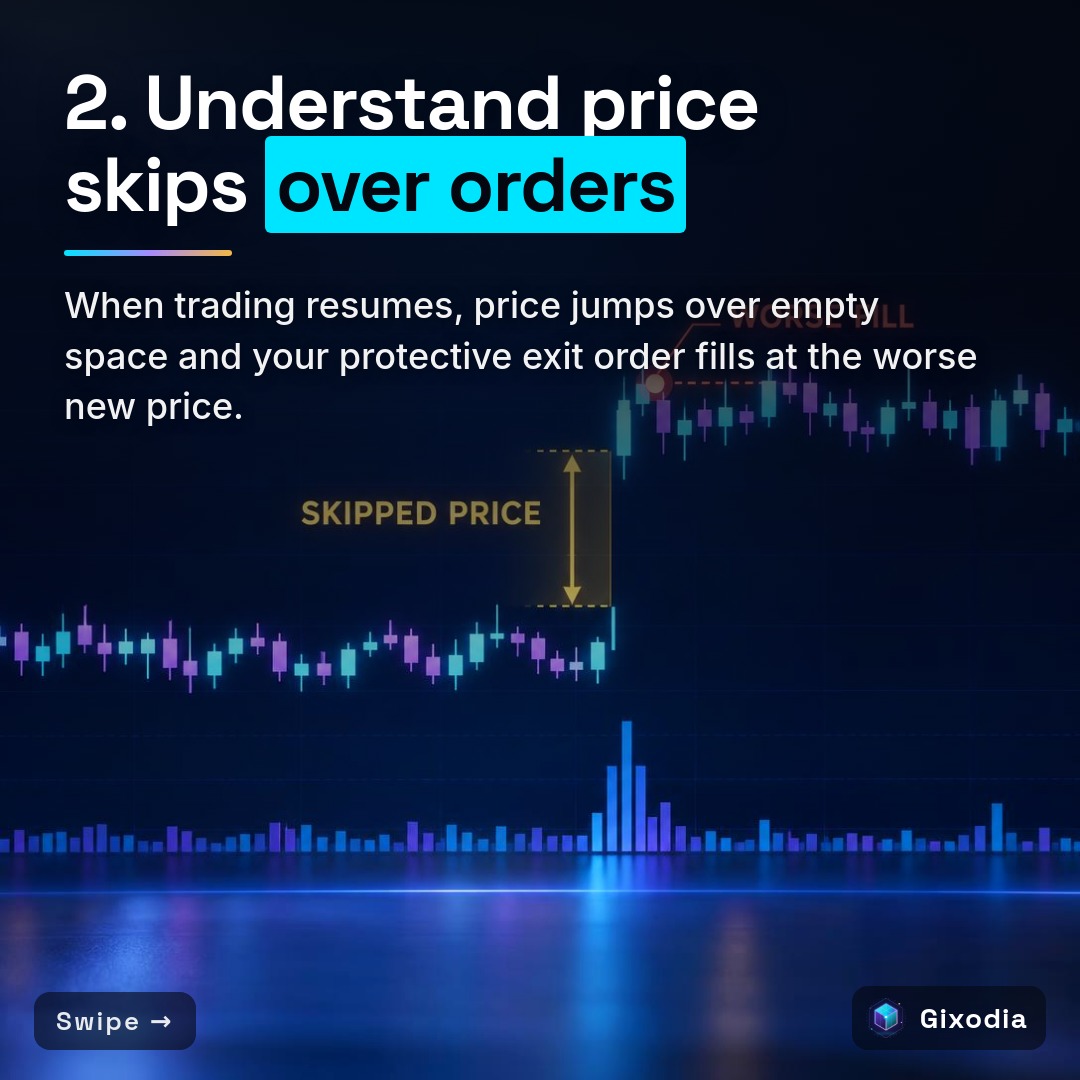
- A weekend gap skips intermediate prices, meaning pending orders and stops fill at the next available quote instead of your selected price.
- MetaTrader 5 and automated systems cannot manage or adjust trades while markets are closed because code processes commands only when new price ticks arrive.
- Sunday reopening spreads widen sharply as banks slowly bring liquidity online, so entering manual trades during the opening hour is hazardous.
- Common gaps in calm conditions often fill back toward Friday's close, but news-driven breakaway gaps tend to run in the direction of the jump.
What is a weekend price gap?
A weekend price gap is a sharp jump between Friday's closing price and Sunday's opening price on a chart, where no trading activity occurred at intermediate levels. It happens because international events alter asset values while exchange servers and retail brokerages pause order execution.
In the spot forex market, regular trade execution halts around 5:00 PM EST on Friday and resumes around 5:00 PM EST on Sunday. Over those 48 hours, exchange matching engines remain dormant. Meanwhile, the real world keeps turning. Political elections finish, conflicts erupt, and policy makers publish emergency press releases outside normal business hours. Understanding how forex markets work means recognizing that real-world valuation never freezes just because retail terminals go silent.
When trading desks reconnect on Sunday evening, the very first matched trade dislocates away from where the last contract settled on Friday. On your terminal, this looks like an empty space between two candles. This gap represents unquoted territory, a pricing void where no buyer and seller met during the weekend.
Why does your stop loss slip during a Sunday open?
A standard stop-loss order is a conditional order that activates only after its trigger price trades, converting immediately into a standard market order. If Sunday trading reopens past your chosen level, the broker executes your trade at the next available quote, creating negative slippage.
Many beginner traders mistakenly believe that placing a stop loss locks in an exact exit price no matter what. Regulatory bodies such as the SEC point out that stop orders do not assure a specific fill price. If EUR/USD settles on Friday at 1.0850 and your protective stop sits at 1.0820, an unexpected Sunday shock might open the market straight at 1.0780. Because no trades occurred between 1.0850 and 1.0780, your order triggers and executes right at 1.0780. The extra thirty pips of loss are called slippage, and the cost falls entirely on your account balance.
This dynamic explains why understanding spread commission slippage is foundational for anyone holding positions across market halts. When an order slips past your planned boundary, your calculated trade risk ceases to exist. If you leave oversized positions open over the weekend, that jump can drain a substantial portion of your margin before you even load your charts.



What happens to trading software and indicators when markets close?
Automated trading software, indicators, and alerts pause completely while market venues are closed because code runs only when new price updates arrive. When the Sunday session opens, all accumulated price changes hit the program at once, causing queued instructions to execute simultaneously.
Platforms like MetaTrader 5 operate strictly on incoming ticks, which are individual updates to the current buy and sell quotes. If the exchange is closed, ticks do not flow into the platform. A running MT5 Expert Advisor cannot monitor, modify, or exit an active position on a Saturday afternoon because its underlying logic has no data to evaluate. No script can anticipate what headlines will print during the downtime.
This operational pause highlights why rule-based consistency matters. A disciplined automated system does not guess what politicians will announce. Instead, sound setups use strict code that manages trade exposure during active hours. For example, Gixodia's trading software places trades on your account by fixed rules, trading the same way every time without panic or second-guessing. Knowing how code behaves during market breaks helps traders build realistic expectations around automated tools.
| Feature | Common Exhaustion Gap | News Breakaway Gap |
|---|---|---|
| Primary Driver | Routine order imbalances or minor weekend noise | Major geopolitical events or emergency rate statements |
| Price Behavior | Tends to reverse quickly and fill back to Friday's close | Runs forcefully in the direction of the gap without retracing |
| Standard Approach | Fade the jump once Sunday spreads settle | Avoid counter-trend trades or stand completely aside |
| Risk Profile | Moderate, but vulnerable to early spread widening | Severe, easily skipping stops and causing deep account damage |
How do wide Sunday opening spreads magnify trading risk?
Sunday opening spreads widen dramatically because major institutional participants and interbank market makers reconnect gradually, leaving the order book exceptionally thin. This wide spread inflates execution costs and can trigger protective stop orders prematurely on the first tick.
The spread is the difference between what buyers want to pay and what sellers demand. During active midday trading, high liquidity keeps this gap tight. When the session resumes on Sunday evening, global liquidity is scarce. Banks, commercial funds, and clearing houses take time to bring their full quoting books online. Because so few market participants offer trades, the spread balloons to several times its normal width.
This sudden spread widening can trigger your stop loss even if the actual mid-market price never touched your target level. If a buy trade carries a stop loss resting just beneath Friday's low, a Sunday spread blowout can hit that price immediately upon reconnecting. For retail participants, diving into trades within the opening thirty minutes exposes your capital to severe transactional friction.
How do traders manage weekend gap risk systematically?
Traders manage weekend gap risk either by flattening all open positions before Friday afternoon to eliminate exposure entirely, or by significantly downsizing lots to ensure potential price jumps remain well within daily risk limits.
Professional intraday operators and participants in funded evaluation accounts often enforce a strict zero-exposure rule. They close every active ticket an hour before Friday's settlement bell. By going to cash, you remove the possibility of waking up to an unmanageable surprise. When you hold nothing, an unexpected weekend geopolitical shock cannot harm your capital balance.
Swing traders who choose to maintain exposure over the weekend must adapt their sizing. Using proper pip and lot size explained principles, they calculate the worst potential gap against a major structural area and scale down their position volume. Cutting lot sizes ensures that even if Sunday opens fifty pips against the trade, the total monetary loss remains within acceptable portfolio parameters.
How to do it, step by step
- Audit your economic calendar on Friday afternoon. Review major international news schedules for the upcoming weekend, including scheduled summits, election ballots, or unscheduled monetary announcements, to see if volatility is elevated.
- Flatten day trades before the Friday close. Decide on a fixed cutoff time, such as two hours before the trading halt, and close any short-term positions on EUR/USD or gold (XAU/USD) directly inside MetaTrader 5.
- De-leverage any swing positions you intend to keep. If you must hold long-term trades, close partial volume to reduce margin usage so your account can easily withstand an adverse jump past Friday's closing quote.
- Cancel all stale pending orders. Remove resting buy stop, sell stop, buy limit, and sell limit orders from your terminal window so an erratic opening spike does not trap you in an unwanted trade.
- Wait out the opening thirty minutes on Sunday. Keep your hands off the terminal when Sunday trading begins, letting interbank spreads settle down to normal widths before evaluating new trade setups.
Checklist before you take the trade
- Check Friday closing times for your specific broker server.
- Close open intraday trades before the market halt arrives.
- Delete unexecuted pending orders sitting on the terminal.
- Verify that remaining position sizes account for potential slippage.
- Avoid placing market orders within the first thirty minutes of the Sunday open.
- Confirm normal spread conditions before entering fresh setups.
Common mistakes and how to fix them
✗ The mistake: Believing a standard stop loss provides an absolute exit price over the weekend.
✓ The fix: Remember that stops convert to market orders upon open; if you cannot afford gap slippage, close the trade on Friday.
✗ The mistake: Widening stop boundaries on Friday afternoon in hopes of giving the trade room to breathe.
✓ The fix: Never move your exit farther away from entry; either accept the original risk boundary or close the trade manually.
✗ The mistake: Jumping into fresh positions the very second trading resumes on Sunday.
✓ The fix: Wait fifteen to thirty minutes for institutional market makers to connect and spread widths to return to baseline.
Frequently asked questions
Do weekend price gaps always fill?
No, weekend gaps do not always fill. While minor gaps during quiet news cycles often drift back to Friday's close, gaps triggered by severe macroeconomic or geopolitical news frequently run further without returning.
Why is the Sunday open spread so high on EUR/USD and gold?
Institutional liquidity providers bring their quotation engines online gradually on Sunday evening. With very few orders on clearing books, the difference between the bid and ask price expands sharply.
Can automated software stop a loss on Saturday?
No, automated software cannot execute actions on a Saturday because market servers are shut down. Expert Advisors process commands only when fresh price updates arrive after trading reopens.
How can day traders completely eliminate weekend gap risk?
The only way to eliminate weekend gap risk entirely is to close all active trades and delete resting pending orders before Friday's official closing bell.
Want your trading to follow fixed rules, the same way every time? Gixodia's trading software for MetaTrader 5 trades by predefined rules on your own broker account, in your own name. Try it free for 10 days, a demo account is fine. Trading involves risk and you can lose money.
Sources
- sec.gov
- Surviving the Sunday Open: Understanding Weekend Gap Risk (edgeclear.com)
- Weekend Gap: Definition | LuxAlgo Library (luxalgo.com)
- Weekend Gaps in Forex: Why They Happen and How to Protect Your Trades | PipsPlus (pipsplus.com)