 GIX
How to Manage Weekend Gap and News Risk in Algorithmic Trading

- Market execution halts completely over the weekend, but world events and news continue without interruption.
- A standard stop loss converts to a market order upon reopening, meaning an adverse gap fills at the first available tick with severe slippage.
- Automated scripts can check server time on Friday afternoon to flatten trades before closing spreads jump.
- Wide opening spreads on Sunday evening can trigger false entries or premature stops if an algorithm lacks spread filters.
What is a weekend gap in electronic trading?
A weekend gap is an abrupt price dislocation that occurs when a market reopens on Sunday evening at a significantly higher or lower price than Friday's close, skipping intermediate price levels entirely.
In financial markets, continuous price discovery requires active matching engines where buyers and sellers post limit orders. When retail forex and futures venues close on Friday afternoon, trading operations halt completely. However, economic developments, political announcements, and geopolitical shifts do not stop for the weekend [1]. As market participants digest fresh headlines during off-hours, their collective valuation of an asset shifts while the order books remain inactive.
When electronic matching engines resume on Sunday evening, buy and sell orders match at a new equilibrium price. If demand has surged or dropped while trading was paused, the market prints its first transaction far away from Friday's final tick. For example, if EUR/USD closes Friday at 1.0850 and emergency policy news breaks on Saturday, the opening quote on Sunday might register at 1.0790. The chart displays a blank space because no transactions occurred between those two numbers [1].
Why does a stop loss fail to prevent weekend gap slippage?
A stop loss fails to protect against gap slippage because it is a conditional trigger that activates only after a price trades, converting to a market order filled at the next available quote.
Many beginner traders believe that placing a stop loss creates an ironclad exit price. In reality, broker infrastructure treats a stop loss as a price threshold that sends a liquidation order into the market once breached [3]. When trading is paused, your broker cannot execute orders. If the market reopens on Sunday below your stop price, the system cannot fill your exit at the price you selected because that level never existed during open trading [3].
Instead, your stop loss converts to a market order instantly upon the market reopening and fills at the first available trade quote. If you held a long trade on gold (XAU/USD) with a stop loss at 2,640 and unexpected geopolitical news causes Sunday trading to open at 2,620, your position exits at 2,620. This difference between your intended stop and the actual exit is known as slippage. In extreme cases, this sudden price leap can bypass regular risk boundaries entirely, which is why understanding spread commission slippage is essential for anyone running automated systems.



How do automated trading bots handle Friday market closures?
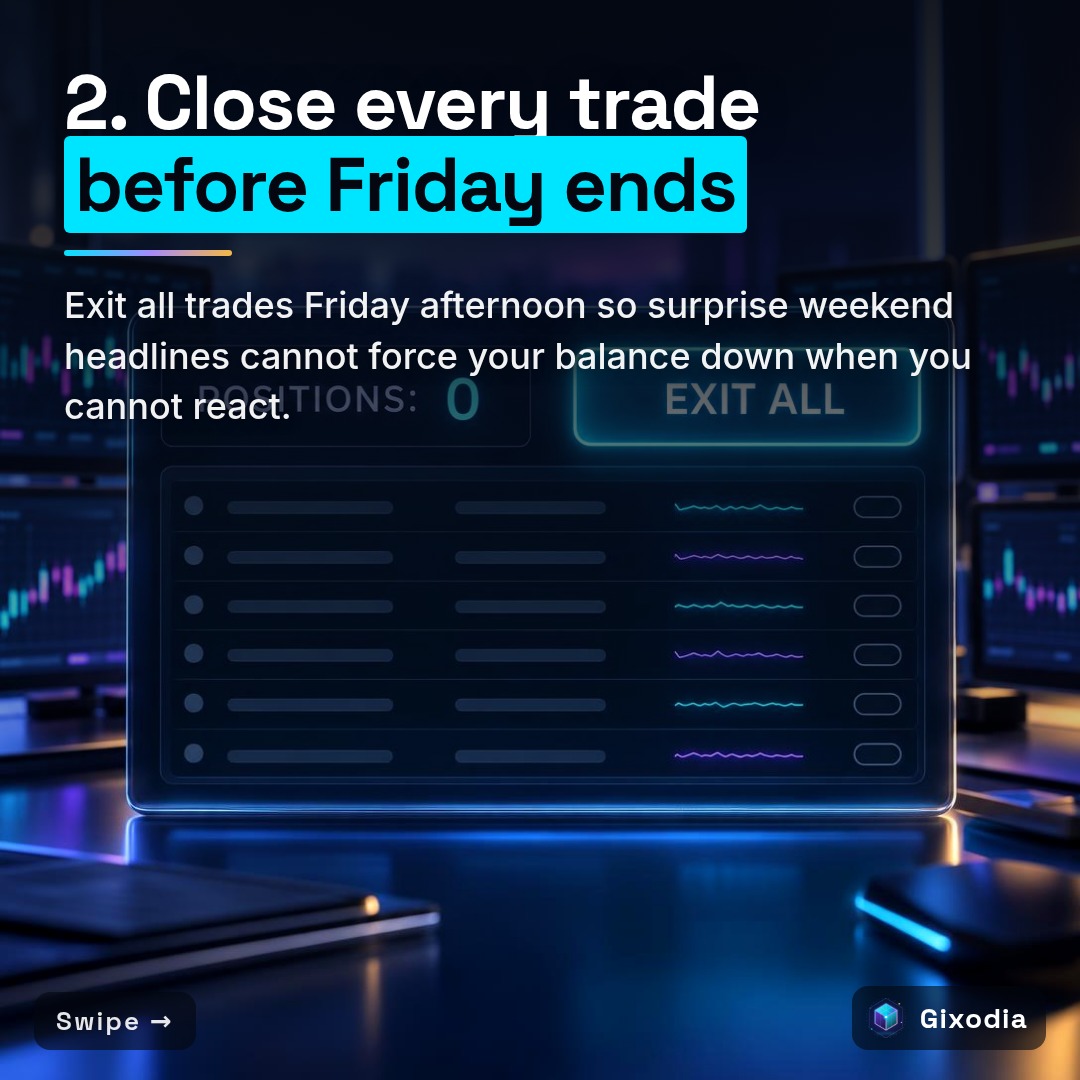
Automated trading bots handle Friday market closures by using coded time filters that close open trades, cancel pending orders, and suspend execution rules before liquidity deteriorates at the end of the week.
Running an Expert Advisor on MetaTrader 5 gives traders the advantage of programming strict schedules that remove human hesitation. Many professional strategies include pre-weekend de-risking routines [6]. These routines track the platform server time. When the clock hits a specified cutoff, often two to three hours before the Friday close, the software checks for open positions and closes them automatically.
Systematic algorithms follow predefined instructions every time without second-guessing market momentum. This structural discipline is central to sound risk management mt4 ea design. By closing positions systematically on Friday afternoon, an automated strategy prevents unexpected weekend announcements from impacting the account balance before Sunday's session begins. Furthermore, software can cancel pending limit orders that might otherwise get swept into unfavorable fills during Sunday's opening volatility.
| Feature | Holding Over Weekend | Systematic Friday Flattening |
|---|---|---|
| Gap Exposure | High; vulnerability to discontinuous price skips on Sunday open | Zero; cash balance is unaffected by off-hours headlines |
| Stop Loss Execution | Fills at the opening tick, often far beyond the intended stop level | Not applicable; positions are already closed before the pause |
| Spread Costs at Reopening | High; wide Sunday spreads can trigger stops instantly | None; trading waits until liquidity stabilizes on Monday |
| Algorithmic Control | Passive; the system cannot manage quotes while matching engines are halted | Active; the algorithm executes rule-based exits before market close |
What happens to liquidity and spreads when trading reopens on Sunday?
When trading reopens on Sunday evening, market liquidity is exceptionally thin and spreads widen dramatically because major institutional desks have not yet opened for the week.
Global forex trading kicks off with the Asian session on Sunday evening, but institutional volume remains sparse for several hours. During this initial reopening window, the spread, which is the gap between the buy price and the sell price, jumps far beyond normal levels. Liquidity providers step back, meaning there are very few active orders resting in the order book. Even a modest transaction can move the market rapidly across several points.
This wide bid-ask spread creates hidden hazards for algorithmic setups that remain active across the weekend. For instance, an algorithm with a tight profit target or stop loss might find its orders triggered purely by spread expansion, even if the underlying asset price has barely moved. Traders looking at the best hours to run bot usually program systems to sleep during the first few hours of Sunday trading until European and American participants return to normalize liquidity.
How do algorithmic rules manage Sunday gap fills and trend continuation?
Algorithms manage Sunday price gaps by measuring the statistical size of the displacement and applying either mean-reversion rules to target the Friday close or trend-following filters to ride breakout momentum.
Once the market opens with a price jump, automated scripts can calculate the exact gap size by subtracting Friday's closing price from Sunday's opening price. Traders who exploit gaps generally classify them into two categories: mean-reversion setups, often called gap fades, and momentum continuation setups. If the gap is caused by temporary weekend sentiment without structural economic change, a gap fade algorithm buys an opening drop or sells an opening spike, targeting a return to Friday's close [1].
Conversely, if a central bank announces a major policy pivot over the weekend, the gap often represents genuine fundamental repricing. In such instances, attempting to fade the move can cause severe losses as price continues aggressively in the direction of the gap. Algorithms handle this by checking volatility indicators like the Average True Range (ATR) or by requiring the first 15-minute bar to close before validating an entry. Understanding how forex markets work under discontinuous conditions allows traders to implement programmatic spread checks before risking capital on gap trades.
Why rule-based execution outperforms manual weekend risk decisions
Rule-based execution outperforms manual decisions by eliminating the emotional hesitation and cognitive bias that often prevent traders from taking small losses to protect their balance before markets close.
Manual traders often struggle with pre-weekend risk because closing an open trade in a small loss feels uncomfortable. A human trader staring at a floating drawdown on Friday afternoon often convinces themselves that the market will turn around on Monday morning. They leave the position open, hoping for a favorable open, only to face an adverse weekend gap that doubles their loss before they can click their mouse.
In contrast, algorithmic software operates purely on logical criteria. Gixodia's trading software trades by predefined rules, the same way every time, free of hesitation, fatigue and emotion, so it does not trade in a panic. Systematic automation enforces rules reliably, ensuring that positions are trimmed or exited regardless of sentiment. For traders exploring what is algorithmic trading, this elimination of hope-driven decision-making represents one of the strongest defenses against unexpected weekend shocks.
How to do it, step by step
- Audit Friday Open Exposure. Review your active trades and open orders inside MetaTrader 5 two to three hours before the official Friday session close.
- Execute Scheduled Position Closures. Close open trades manually or allow your pre-programmed time exit script to liquidate positions to ensure a flat account balance over the weekend.
- Cancel Pending Limit and Stop Orders. Remove active buy limit, sell limit, or breakout stop orders from your terminal so erratic opening spreads do not trigger unintentional fills.
- Implement Maximum Spread Filters. Set a spread protection threshold inside your Expert Advisor settings so the software automatically pauses entries if the bid-ask gap exceeds typical weekday levels.
- Review the Sunday Economic Calendar. Check scheduled geopolitical summits, central bank statements, and Asian market data releases scheduled prior to Sunday's electronic open.
- Re-enable Algorithmic Execution Gradually. Wait for the Sunday opening session to settle and liquidity to return before switching your automated execution button back to active status.
Checklist before you take the trade
- Confirm that server time rules are set to close positions before Friday afternoon liquidity drops.
- Verify that all pending orders are cleared so wide weekend spreads do not cause accidental fills.
- Check that your broker server connection is active and stable on your VPS before the market close.
- Review whether high-impact election results or international summit meetings are scheduled over the weekend.
- Confirm your algorithm spread limit is configured to reject trades during wide Sunday reopening spreads.
- Ensure position volume has been scaled down if your trading plan allows holding across weekend sessions.
Common mistakes and how to fix them
✗ The mistake: Relying on a standard stop loss to cap losses over the weekend.
✓ The fix: Flatten open trades on Friday afternoon or size trades so that an opening gap cannot exceed your risk budget, recognizing that stop losses execute at opening market prices.
✗ The mistake: Allowing algorithmic trading bots to enter new positions on Sunday open without spread filters.
✓ The fix: Add a maximum spread check in your software settings that blocks order execution until the bid-ask difference returns to normal baseline levels.
✗ The mistake: Running backtests that assume zero slippage across weekend price jumps.
✓ The fix: Configure backtesting parameters to account for opening price gaps and historical Sunday spreads so strategy models match real market mechanics.
✗ The mistake: Holding full position sizing across weekends to avoid booking a minor floating loss on Friday.
✓ The fix: Enforce automated Friday time exits so small paper losses are closed systematically rather than gambled against off-hours headlines.
Frequently asked questions
Can a weekend gap jump completely past my stop loss order?
Yes. A stop loss order is a trigger that becomes an active market order only when its designated price trades. If the market reopens on Sunday below your stop price, the order executes at the first available market quote, which can cause significant slippage.
Why do brokers have wider spreads when the market reopens on Sunday?
Spreads widen because major institutional banks and liquidity providers do not actively trade in size during Sunday evening hours. With fewer market participants submitting quotes, the gap between the buy price and sell price expands until regular sessions begin.
Should automated trading bots always be turned off before the weekend?
Most intraday and short-term algorithms benefit from pausing execution or flattening exposure before the Friday close. Doing so eliminates the risk of off-hours news gaps and prevents wide Sunday spreads from triggering unwanted orders.
What is the difference between a gap fade and a gap continuation strategy?
A gap fade strategy bets that price will reverse and fill the gap back to Friday's closing price as liquidity normalizes. A gap continuation strategy enters in the direction of the jump, assuming fresh fundamental news will drive a sustained trend.
Want your trading to follow fixed rules, the same way every time? Gixodia's trading software for MetaTrader 5 trades by predefined rules on your own broker account, in your own name. Try it free for 72 hours, a demo account is fine, then $499/year. Trading involves risk and you can lose money.
Sources
- Weekend Gap Explained: Trading Gaps Between Friday Close and Monday Open (damanmarkets.academy)
- Weekend price gap risk and your stop-loss (ouinex.com)
- mql5.com