 GIX
How to Protect Your Trading Account When Surprise Government News Drains Market Liquidity

- A standard stop loss triggers an exit instruction when reached, but it does not ensure an exact fill price in an empty market.
- Surprise state policy headlines cause market makers to withdraw liquidity, widening the spread instantly.
- Pre-trade volume caps prevent an unexpected news event from wiping out your balance on a single trade.
- Stop-limit orders cap your maximum acceptable price fill, but they risk leaving you trapped in an open trade if price jumps past your limit.
- Automated trading software can enforce hard pause rules and scale down risk as loss thresholds approach, eliminating hesitation.
What happens to market liquidity during surprise government announcements?
Market liquidity vanishes during surprise government announcements because liquidity providers instantly cancel their resting bids and offers to avoid holding toxic inventory. This sudden withdrawal clears out the order book, creating price gaps where trades cannot execute until new orders arrive at much wider price levels.
When an unscheduled government statement or policy shock crosses the news wires, market makers do not stand in place to absorb incoming volume. Instead, their automated systems pull active quotes off the board within milliseconds. What was once a deep order book with small spreads instantly turns into a vacuum. You might look at a chart showing steady two-way traffic, but underneath, the volume required to fulfill orders has vanished.
This dynamic frequently impacts major currency markets like EUR/USD or spot gold (XAU/USD). If a sudden state announcement regarding fiscal controls, emergency trade barriers, or monetary shifts occurs, institutional desks step aside. With nobody willing to take the other side of standard retail trades, buyers must accept much higher ask prices, and sellers must accept substantially lower bids.
Understanding this structural drain is the first step in surviving unannounced geopolitical or central bank statements. You can read more about how macro shocks hit currency valuations in our breakdown of central bank forex policy. When participants withdraw, standard pricing assumptions stop functioning until the initial shock settles.
Why does extreme slippage occur even when you use a stop loss?
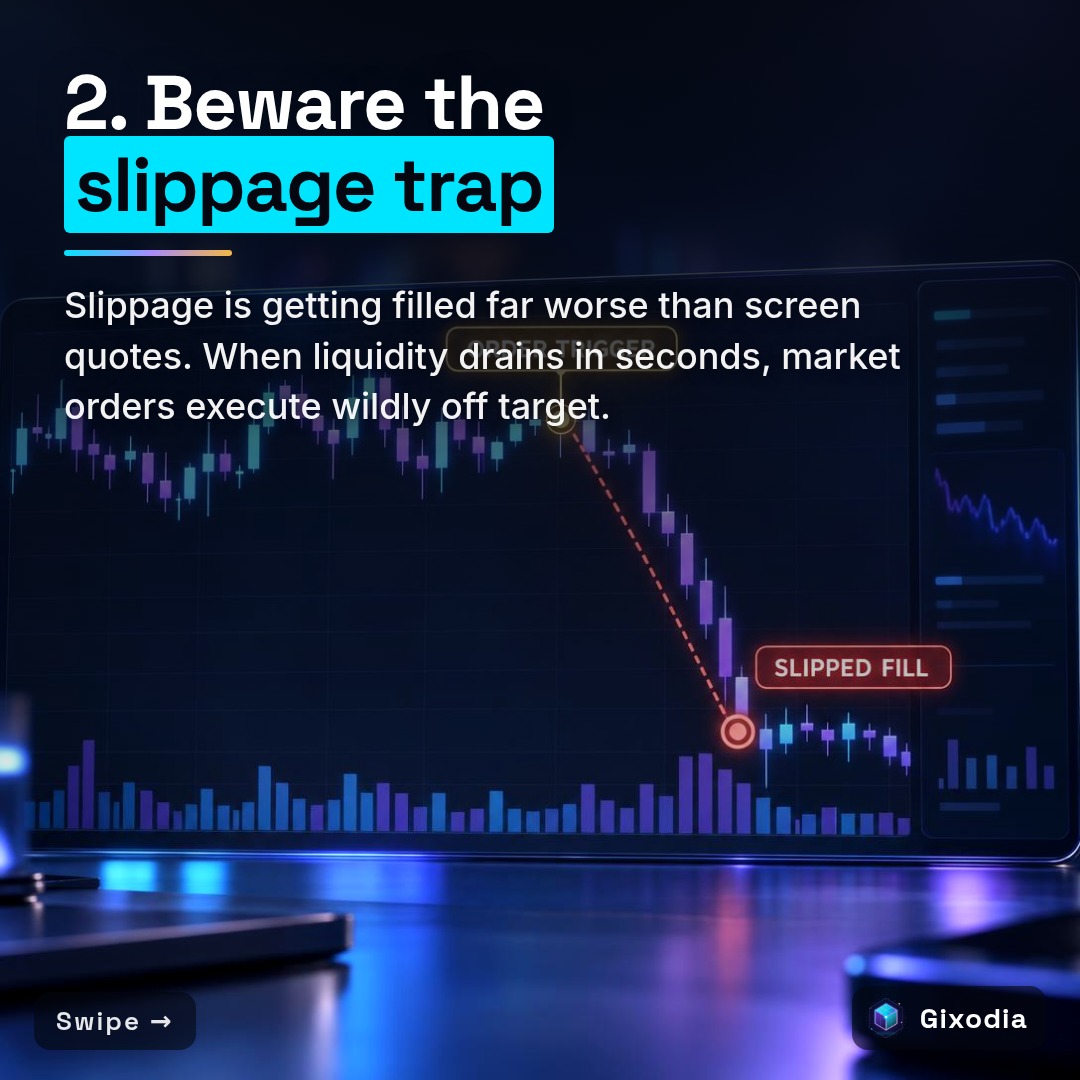
Extreme slippage occurs because a standard stop loss is an instruction to trigger a market order, not an absolute price promise. Once the market reaches your designated trigger price, the platform sends an order to close the trade at the next best available quote, which may sit far beyond your level.
Many retail traders operate under the false assumption that a stop loss locks in an exact dollar boundary. As regulatory guidance from financial watchdogs clarifies, a stop loss order simply monitors price feeds until the stop price is hit. Once touched, it submits a market order to your broker. In normal conditions, the next available price matches your chart level closely. However, during a fast market gap, there are no bids or offers sitting directly at your stop line.
For instance, imagine you hold a long position in EUR/USD with a protective stop at 1.0850. If an unannounced government announcement sends a wave of selling through the market, the quote may jump instantly from 1.0852 down to 1.0820 without printing a single price in between. Your stop triggers at 1.0850, but because the book is empty, your trade executes at 1.0820. You absorb thirty pips of unexpected negative slippage.
This gap between expectation and execution is why traders must grasp the core mechanics of understanding spread commission and slippage. The broker is not necessarily acting against you; rather, there were simply no counterparties present to absorb your exit at the intermediate levels.

How do stop-limit orders help control execution risk?
Stop-limit orders protect execution by defining the maximum deviation you will accept, converting to a limit order once the trigger price is touched. This boundary eliminates uncontrolled market-order fills during sudden dislocations, though it carries the risk of leaving the trade open if price gaps past your limit.
To avoid getting filled yards away from your stop, you can employ alternative order routing inside platforms like MetaTrader 5. A stop-limit order lets you enter two distinct parameters: the stop price, which activates the order, and the limit price, which sets the worst price you are willing to take. If market quotes jump completely past your limit price during a surprise headline, your order refuses to execute.
While this protects you from an abysmal fill, it comes with a major tradeoff: your position remains open while the market moves against you. If the price continues falling without returning to your limit boundary, you face accumulating paper losses with no exit in place.
Traders using automated systems must weigh whether an unfilled stop-limit trade presents more account danger than a slipped market order. For high-volatility environments, evaluating your platform settings alongside risk management mt4 ea strategies helps clarify how your exits will execute when liquidity thins.
| Order Type | Execution Mechanism | Slippage Vulnerability |
|---|---|---|
| Standard Stop Loss | Converts to a market order once trigger price touches | High: Fills at the next available price across the order gap. |
| Stop-Limit Order | Converts to a limit order bounded by your limit price | Zero price slippage, but high risk of failing to fill entirely. |
| Market Order | Executes immediately against whatever liquidity remains | Severe: Fills across depleted books at substantially worse quotes. |
How can pre-trade volume caps protect your account balance?
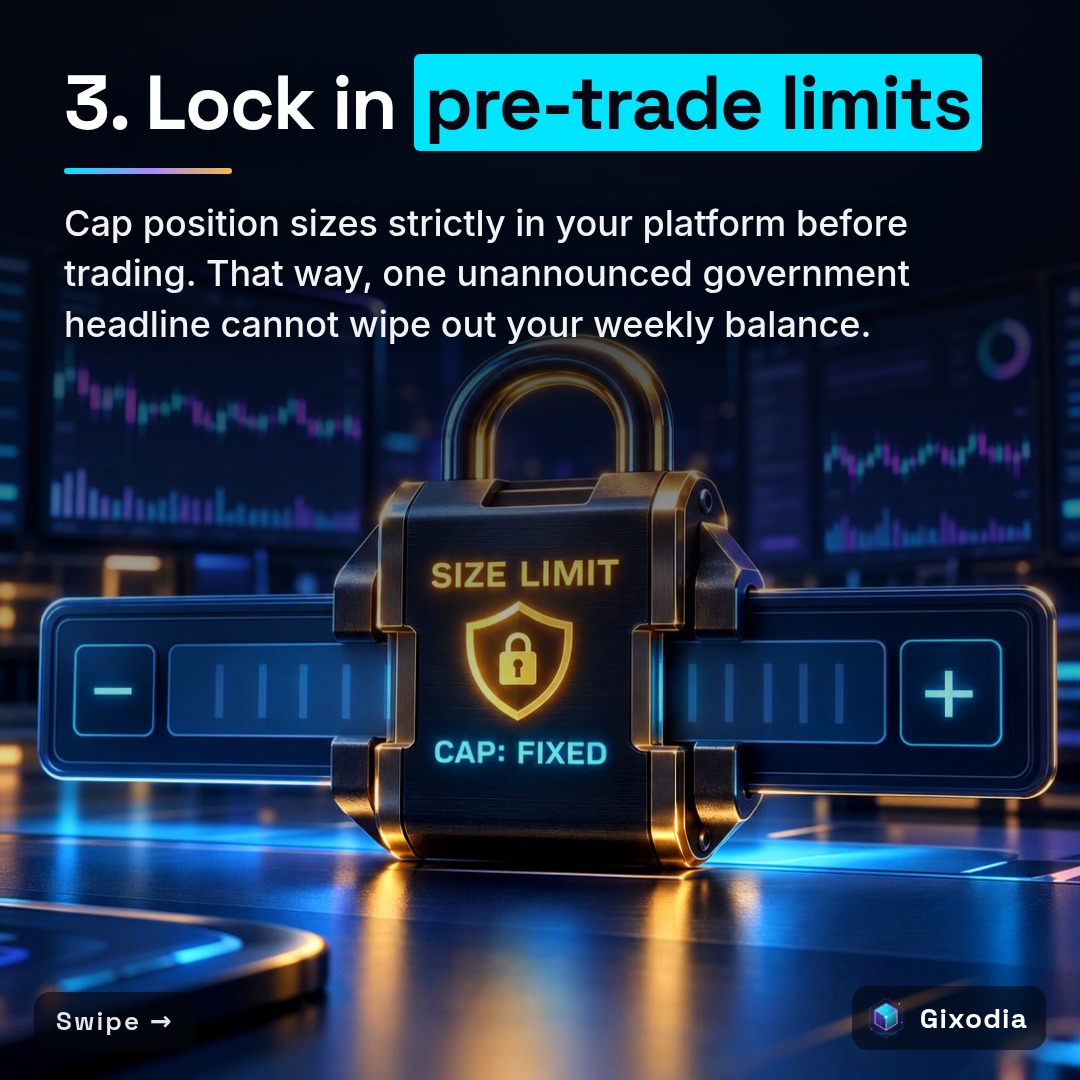
Pre-trade volume caps protect your account balance by restricting individual position sizes to a fraction of your total capital, ensuring that a single slippage event cannot generate catastrophic drawdown. Hardcoding these limits stops emotion from expanding trade exposure ahead of unstable news periods.
When sudden government statements shake the market, position sizing determines whether an account survives. If you risk three percent of your capital based on a ten-pip stop, but that stop slips by thirty pips due to an empty order book, your actual loss triples to nine percent in a single moment. By enforcing conservative base position sizing, you build an automatic buffer that absorbs violent price extensions.
Sizing discipline requires configuring strict maximum lot sizes inside MetaTrader 5 before trading begins. Never rely on manual discretion when high-impact headlines are circulating. You can review our detailed guide on pip and lot size explained to balance your exposure properly against your account equity. Setting hard position caps ensures that even an extreme liquidity hole only dents your equity rather than ending your trading career.
This rule applies whether you trade manually or execute through algorithms. Keeping position volume tied strictly to conservative thresholds allows market participants to endure abnormal volatility events without facing margin calls or forced account liquidations.
Why do automated pause rules prevent panic during market turmoil?
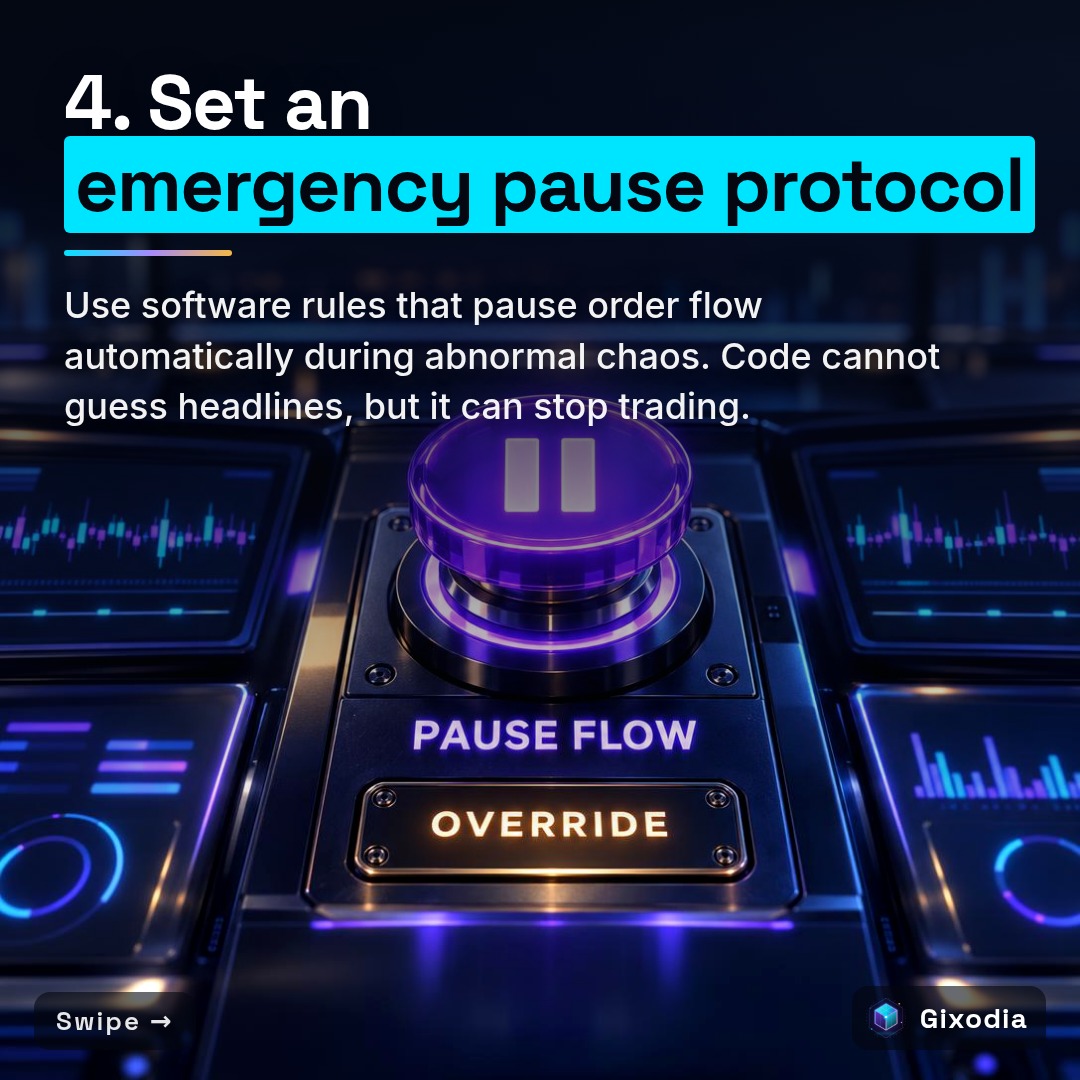
Automated pause rules prevent panic by using pre-set code parameters that freeze order execution when spread widening or price velocity exceeds normal thresholds. This removes emotional reactions and prevents traders from buying or selling directly into illiquid price spikes.
During wild market moves, manual traders often succumb to fear or revenge trading, trying to catch falling knives or desperately exiting at the worst possible quotes. Algorithmic software handles these conditions differently. By operating on predefined rules, automated systems can evaluate incoming market conditions and stop opening new positions when spreads widen beyond an acceptable boundary.
Gixodia builds algorithmic software for MetaTrader 5 that trades by predefined rules, the same way every time, free of hesitation, fatigue, and emotion. The software does not try to predict the market or guess political outcomes. Instead, as a user-configured limit gets close, it scales down risk, and it pauses at that limit. This rules-based design ensures that extreme volatility does not trigger reckless re-entries into a broken order book.
Whether running automated tools or managing charts by hand, adopting an algorithmic mindset shields your psychology. You can explore how structured systems handle extreme drawdowns in our article on how gixodia handles market crashes. Hard rules protect capital when fast news makes human decision-making unreliable.
How to do it, step by step
- Audit platform order execution defaults. Open MetaTrader 5, access your trade execution settings, and verify how pending orders are handled during spread spikes. Ensure your platform allows slippage tolerance caps on market orders.
- Hardcode maximum position sizes. Set strict volume boundaries directly in your platform or Expert Advisor settings so you cannot open oversized trades, regardless of how promising a chart pattern appears.
- Set maximum allowable spread filters. Configure automated rules or alert thresholds that block trade execution if the spread on EUR/USD or gold widens beyond your predetermined limit during unexpected news breaks.
- Incorporate a catastrophic volatility buffer. Calculate your stop loss risk assuming three times the standard spread. Size your position so that severe negative slippage remains within your personal risk tolerance.
- Establish automated pause protocols. Activate equity-based pause rules that automatically shut down trading activities if daily losses cross a predefined percentage, preventing emotional chasing in wild markets.
Checklist before you take the trade
- Verify that your MetaTrader 5 connection is stable and execution permissions are enabled.
- Confirm that maximum position volume caps are locked in before the market opens.
- Check that your stop loss orders are stored on the broker server rather than relying on local machine alerts.
- Review spread sizes across EUR/USD and gold to ensure normal conditions exist before entering.
- Set an equity pause ceiling so your software steps aside if drawdown crosses your acceptable limit.
- Confirm your live trading balance sits comfortably above the minimum operational threshold.
Common mistakes and how to fix them
✗ The mistake: Believing that a stop loss order locks in an exact exit price.
✓ The fix: Recognize that stops trigger market orders, which execute at the next available quote. Size positions smaller to absorb gap slippage.
✗ The mistake: Using aggressive stop-limit orders during high-velocity market crashes.
✓ The fix: Accept that price can skip past a limit level entirely, leaving positions open. Use market-based stop triggers with strict volume sizing if you need an exit to execute.
✗ The mistake: Revenge trading into wide spreads right after an unannounced headline.
✓ The fix: Implement automated pause rules that lock out new trades until spread widths return to baseline averages.
Frequently asked questions
Why did my stop loss execute at a much worse price during news?
A stop loss converts into a market order the moment its price is triggered. If an unexpected government announcement empties the order book, there are no matching orders at your level, forcing your broker to fill your order at the next available price.
Can a broker prevent slippage during surprise announcements?
Brokers route orders to liquidity providers who clear resting orders during panic events. Unless specialized premium protection products are active on an account, normal market mechanics dictate that orders fill where liquidity actually exists.
Is EUR/USD safer from slippage than gold during political shocks?
EUR/USD features deeper overall order book volume than gold under typical conditions. However, an unannounced policy shock affecting government fiscal rules or central bank targets will still drain liquidity rapidly across both assets.
How does automated software protect against slippage?
Automated software enforces strict pre-trade volume caps and spread filters. It trades by predefined rules, scales down exposure as user limits approach, and pauses trading when volatility exceeds set parameters, preventing emotional entries into drained markets.
Want your trading to follow fixed rules, the same way every time? Gixodia's trading software for MetaTrader 5 trades by predefined rules on your own broker account, in your own name. Try it free for 72 hours, a demo account is fine, then $499/year. Trading involves risk and you can lose money.
Sources
- Slippage in Trading: Meaning & How to Reduce It | Velotrade (velotrade.com)
- Slippage & Gaps: Hidden Risk (Not Just Costs) (forexforstarters.com)
- Stop Orders Explained and How They Trigger (tradeify.co)
- cmegroup.com