 GIX
What Happens When Market Trends Break and How Automated Rules Protect Trading Accounts
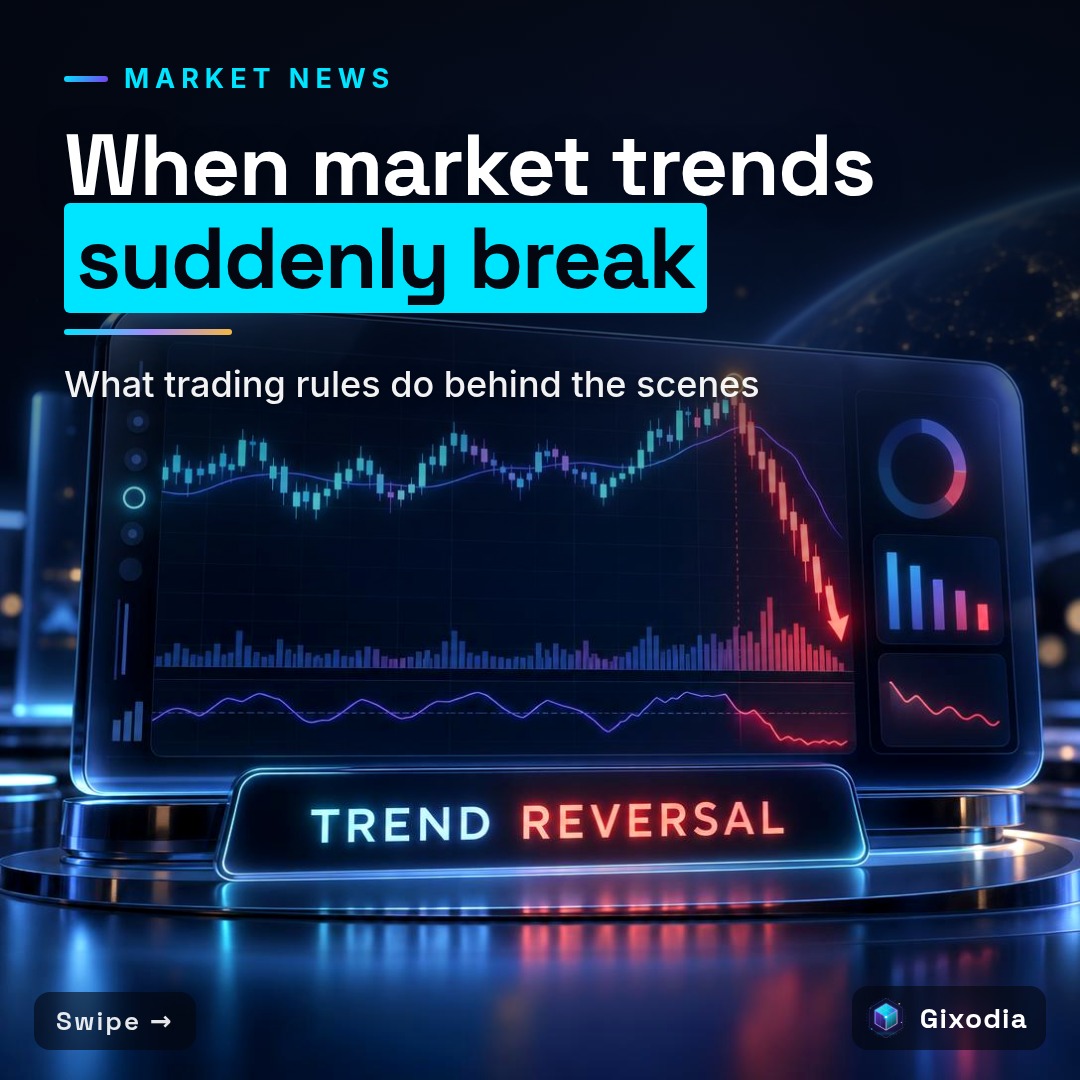
- A trend break occurs when price crosses a structural swing high or swing low, invalidating the previous directional flow.
- A stop-loss order converts into a market order upon reaching the activation price, which means it executes without hesitation but remains subject to slippage.
- Manual intervention during sharp market breaks often causes hesitation or destructive stop widening.
- Predefined automated parameters remove emotional bias by scaling down risk and pausing operations when account boundaries are tested.
- Server-side orders placed inside MetaTrader 5 execute on the broker server even if your home terminal loses power or internet connection.
What happens when a market trend breaks?
A market trend break is a structural shift where price violates key swing highs or swing lows that previously defined directional flow. When this structural boundary fails, momentum reverses rapidly, trapped traders rush to exit their positions, and opposing market orders cascade across the book.
In an uptrend, price steadily prints higher highs and higher lows. Buyers comfortably step in at pullbacks, assuming the flow will continue. A trend break happens the exact moment price violates the most recent higher low. When that structural floor gives way, the market stops behaving like an uptrend. The supply and demand dynamic flips entirely: buyers pull their bids, sellers become aggressive, and late buyers find themselves trapped at unfavorable prices.
Consider EUR/USD climbing steadily throughout the morning. The pair establishes a clear structural swing low at 1.0820 before attempting a new push upward. Suddenly, unexpected macroeconomic pressure enters the market. Instead of bouncing, price drops cleanly through 1.0820. That breach is known as a break of structure. The trend is no longer intact, and anyone holding buy orders based on trend continuation is now holding an invalidated thesis.
Understanding why most retail traders lose during these moments comes down to human psychology. When a trend snaps, retail traders often freeze. They hope for a bounce that never comes, or worse, they average down into a falling market. A structural failure requires immediate defensive action, not optimism.
- Structural boundaries: Swing lows in an uptrend or swing highs in a downtrend are cleared out.
- Liquidity shifts: Opposing orders overwhelm the market, triggering stop runs and rapid price re-pricing.
- Thesis invalidation: The fundamental or technical reason for the trade ceases to exist.
Why do manual traders struggle during sudden reversals?
Manual traders struggle during sudden reversals because cognitive bias and panic delay execution when price moves violently against their positions. Instead of accepting an invalidation quickly, traders experience emotional paralysis, bargain with the market, or widen their stops, turning manageable losses into severe drawdowns.
When you stare at a live candle plunging through your entry level, your brain perceives a threat. Instead of treating the price movement as neutral data, traders feel personal discomfort. This psychological reaction creates hesitation. You might wait for the candle to close, hoping it leaves a long wick. While you wait, price continues moving against you, making the potential loss even more painful to realize.
This dynamic explains why psychology of automated trading is so widely studied. When a human trader manages risk manually, every tick against the balance requires active emotional willpower to accept. Eventually, fatigue sets in. Traders often move their stop loss further away to avoid realizing the loss, violating their initial plan entirely.
A disciplined trader knows that when market structure fails, the trade is dead. However, executing that principle in real time while watching your account equity tick down is remarkably difficult without programmatic discipline.
How do automated rules execute exits without panic?
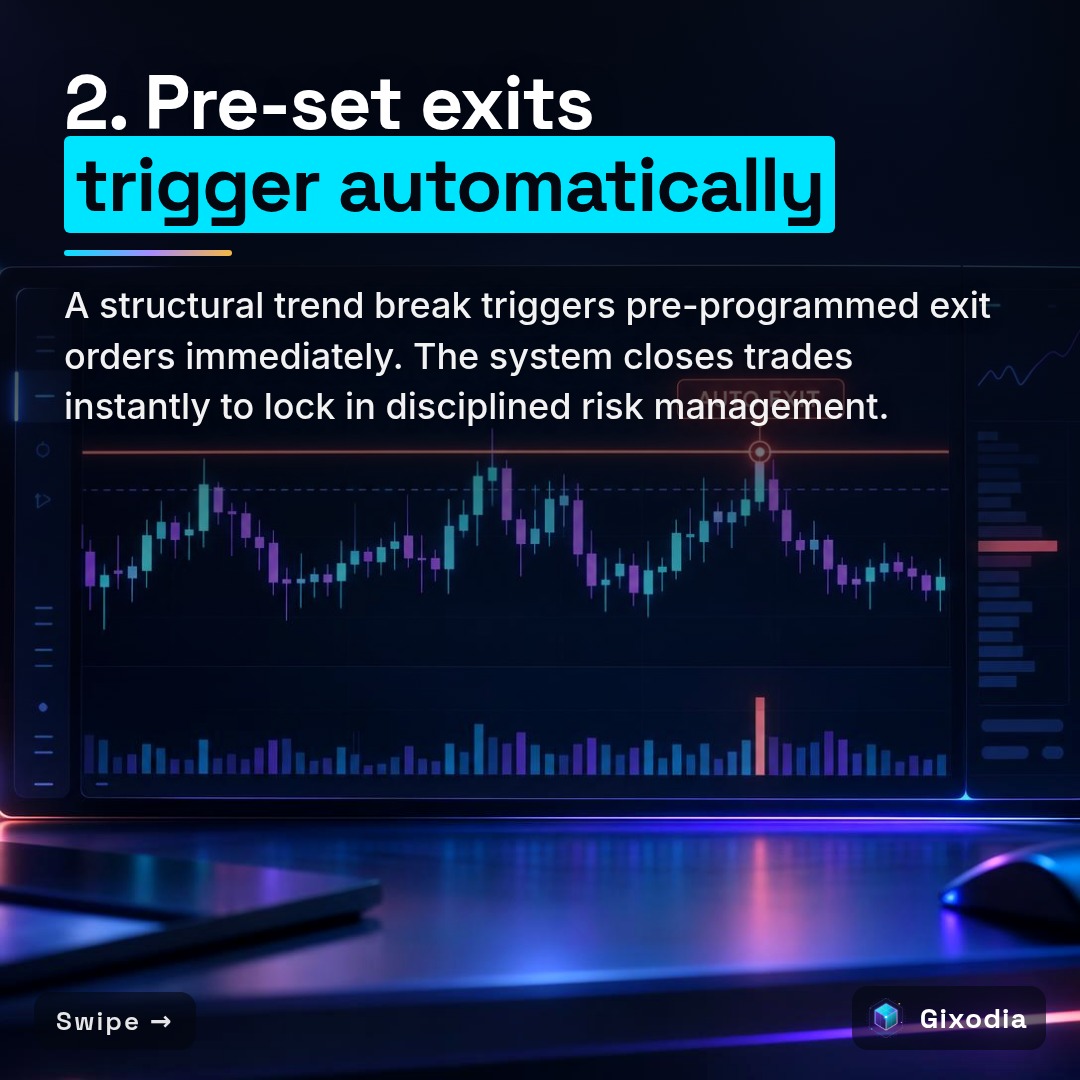
Automated rules execute exits without panic by sending pre-programmed instructions to the broker server the instant an order is placed. When price touches the invalidation level, the server automatically triggers the stop order, closing the position instantly regardless of market emotion or trader sentiment.
A trading bot or Expert Advisor running on MetaTrader 5 does not feel stress, fatigue, or optimism. It operates purely on mathematical logic. When you define an automated strategy, every single position has an entry point, an invalidation price, and an exact exit trigger established before the position ever goes live.
A stop loss is an order placed with your broker to automatically sell or buy an asset once it reaches a pre-set activation price, designed to cap potential losses. In MetaTrader 5, standard hard stop losses reside server-side on your broker's infrastructure. This means that even if your computer shuts down or your home network disconnects, the broker's engine executes the order the moment price crosses that line.
According to regulatory guidance from bodies like FINRA, when a stop order reaches its trigger price, it immediately converts into a market order. It does not wait for confirmation, second thoughts, or emotional clearance. It simply executes at the next available market price, cutting the exposure exactly where the rules require.
| Feature | Manual Trading Reaction | Automated Rule Execution |
|---|---|---|
| Reaction Speed | Delayed by emotional hesitation, disbelief, and double-checking charts | Instant execution upon the trigger price reaching broker servers |
| Handling Invalidation | Traders often widen stops hoping the market turns back around | Strict invalidation closes the position immediately without bargaining |
| Position Sizing | Often irregular or increased in panic to recover quick losses | Fixed calculation based on predetermined risk parameters |
| Account Thresholds | Relies on self-control that frequently fails during drawdown | Automatically scales down exposure and pauses trading at fixed limits |
How do automated risk boundaries protect overall account capital?
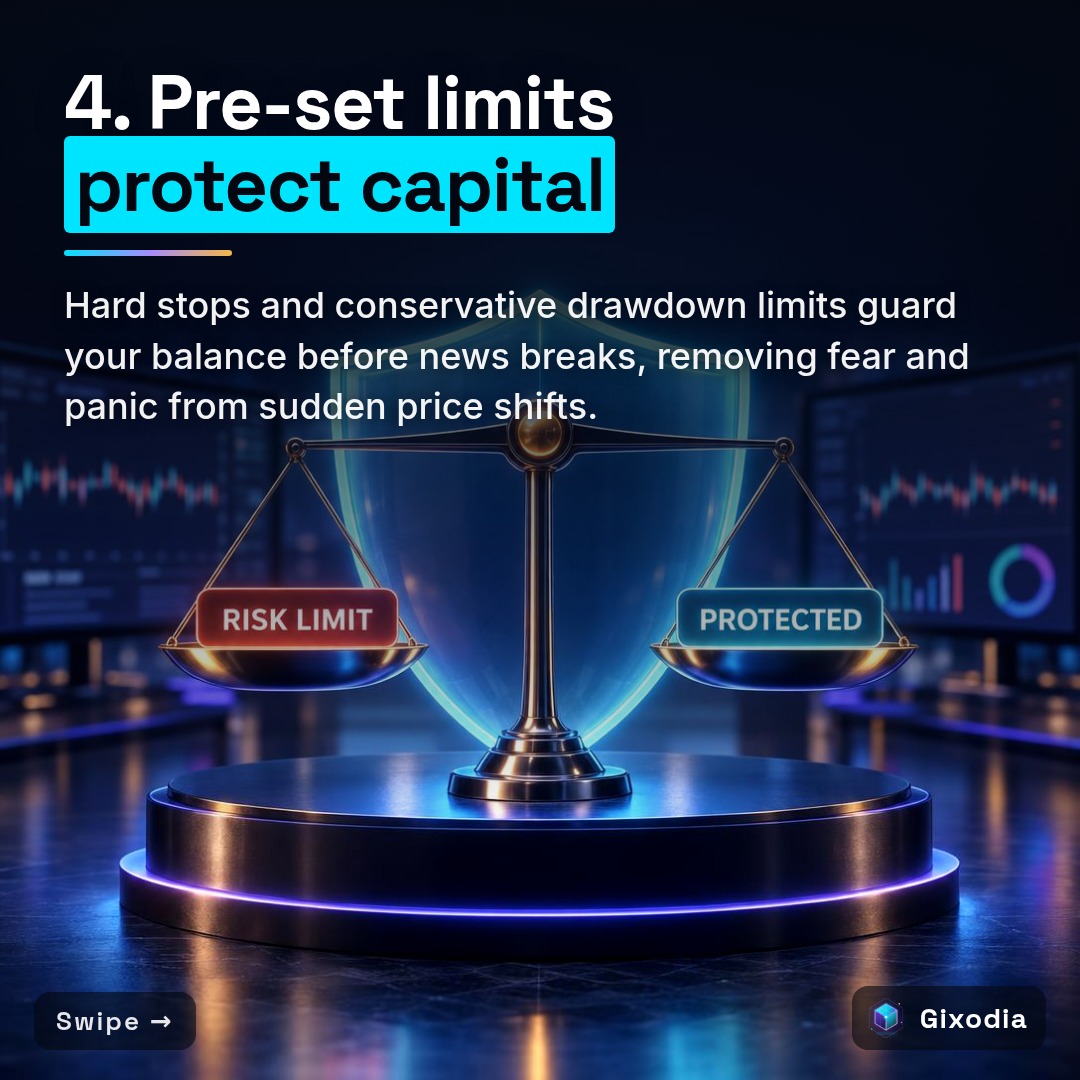
Automated risk boundaries protect overall account capital by enforcing hard drawdown floors and automatically scaling down trade volume as account equity approaches predefined limits. If losses reach a specified ceiling, the software halts all trading activity to preserve remaining capital.
Protecting an account requires more than just trade-level stop losses; it requires system-level risk controls. When market regimes shift rapidly, consecutive losing trades can occur. A human trader experiencing several losses in a row often enters a state of revenge trading, increasing position sizing to make back the lost money. This behavior can destroy an account in a single afternoon.
Automated software manages this risk through balance-level rules. By establishing strict risk management mt4 ea parameters, the system tracks equity drawdowns in real time. For example, Gixodia's trading software trades by predefined rules, the same way every time, free of hesitation, fatigue, and emotion. As a limit you set gets close, it scales down, and it pauses at that limit. It does not try to predict the market.
By taking the decision to pause out of human hands, automated systems prevent catastrophic account wipeouts. The software ensures that tomorrow's trading capital remains intact, allowing you to review performance objectively rather than cleaning up after an emotional spiral.
What is the difference between stop-market and stop-limit orders during trend breaks?
A stop-market order prioritizes execution by converting into an immediate market order once triggered, though it may suffer slippage during fast moves. A stop-limit order only executes at your specified price or better, which eliminates slippage but risks leaving your trade completely open if the market gaps past your price.
Understanding execution mechanics during violent market breaks is vital for any trader running automated systems. In fast-moving markets, such as during major macroeconomic releases or sudden geopolitical breaks, liquidity can thin out rapidly. This means buyers or sellers momentarily vanish at intermediate price increments.
When a standard stop-loss order hits its trigger, it sends a market order. If EUR/USD breaks down sharply, your order fills at the best available bid. The difference between your stop trigger and your actual fill price is known as slippage. While you might take a slightly larger loss than planned due to slippage, your trade is closed, and your exposure is eliminated.
Conversely, a stop-limit order specifies a secondary limit price beyond which the broker cannot fill the order. If price gaps violently past both the stop trigger and your limit threshold, the order remains completely unfilled. In a catastrophic trend reversal, holding an unprotected open position because a limit order failed to fill can ruin an account balance. This is why algorithmic risk systems generally rely on server-side stop-market orders for defensive protection.
How to do it, step by step
- Identify the structural invalidation price. Before opening a trade, inspect the chart in MetaTrader 5 to find the structural swing high or swing low where the current trend thesis is broken.
- Add a volatility buffer using ATR. Measure the Average True Range on your trading timeframe and place your exit trigger slightly beyond the structural swing point to avoid premature exits from ordinary spread fluctuations.
- Calculate position size based on balance risk. Calculate your lot size so that the physical distance between your entry price and stop loss matches your predefined risk budget per trade.
- Attach server-side stop orders in MetaTrader 5. Input the calculated stop-loss price directly into the MetaTrader 5 order window (F9) so the order sits on the broker server before the position is live.
- Configure automated account equity limits. Set account-level rules in your Expert Advisor to scale down lot size as daily loss boundaries approach and pause execution if the limit is reached.
- Step back and allow rules to execute. Refrain from manual intervention during sudden volatility, letting the predefined parameters handle exits without human interference.
Checklist before you take the trade
- Every live trade has an active server-side stop loss configured.
- The stop level sits beyond a structural swing point rather than at a random pip distance.
- Position sizing is calculated to respect your predefined risk limit.
- The stop placement respects your broker's minimum Stops Level distance.
- An automated balance threshold is configured to pause trading during extreme drawdown.
- You have committed to leaving active parameters untouched during fast headline spikes.
Common mistakes and how to fix them
✗ The mistake: Placing stops exactly at obvious swing extremes.
✓ The fix: Add a small buffer beyond the structural swing point to avoid being taken out by minor market noise before the real move occurs.
✗ The mistake: Moving stop-loss orders further away when price moves against the trade.
✓ The fix: Treat stop levels as absolute boundaries that only move in the direction of profit, never into wider loss territory.
✗ The mistake: Intervening manually during volatile trend breaks.
✓ The fix: Rely entirely on pre-programmed server-side exit rules and avoid overriding positions during emotional price spikes.
Frequently asked questions
What is a break of structure in technical analysis?
A break of structure occurs when price moves past a key structural high or low that established the ongoing trend. This movement indicates that the previous market trend has failed and momentum is shifting in the opposite direction.
Will a stop loss protect me from slippage during a trend break?
A standard stop loss triggers an immediate market order once the stop price is reached, which closes your position. However, in fast-moving markets or liquidity voids, the actual fill price may differ from your stop trigger due to slippage.
Why are server-side stop orders safer than client-side orders?
Server-side stop orders reside directly on your broker's trading infrastructure. If your computer crashes, updates, or loses internet connectivity, the broker server still executes the exit order as scheduled.
How does automated software handle sudden market trend reversals?
Automated software trades strictly by predefined rules without emotion. When price hits an invalidation boundary, the software triggers the exit immediately, and as balance limits approach, it scales down trade size and pauses operations.
Want your trading to follow fixed rules, the same way every time? Gixodia's trading software for MetaTrader 5 trades by predefined rules on your own broker account, in your own name. Try it free for 72 hours, a demo account is fine, then $499/year. Trading involves risk and you can lose money.
Sources
- What is Stop Loss? Order Type Explained | TradeTheDay (tradetheday.com)
- Stop Orders: Factors to Consider During Volatile Markets (finra.org)
- babypips.com
- medium.com