 GIX
Why Widening a Stop Loss Always Backfires and How the One-Way Rule Protects Your Balance

- Moving a stop loss mid-trade doubles or triples cash risk without changing your entry position size.
- The one-way rule permits adjusting an exit order toward profit or break-even, never away from market price.
- A protective stop order becomes a market order upon being triggered, meaning fill prices depend on available liquidity.
- Predefining technical invalidation before entry eliminates the psychological urge to bargain with losing positions.
- Automated systems avoid stop-widening by executing predefined parameters on MetaTrader 5 without hesitation.
What is stop loss widening?
Stop loss widening is the practice of moving an active protective exit order further away from the entry price as the market travels against an open trade. This behavioral error stems from emotional distress and directly inflates your cash risk beyond your pre-trade limit.
When you enter a trade, you establish an invalidation level where your trading idea no longer makes sense. A stop loss, the order that closes the trade when it goes against you, acts as a safety ceiling on your balance. Moving this barrier further out while an order sits in a drawdown violates foundational risk principles.
Traders usually widen their stops because taking a small loss feels uncomfortable. They convince themselves that the price just needs room to breathe before reversing. What actually happens is that a controlled risk becomes an uncontrolled gamble, leading directly to why most retail traders lose.
Widening also appears on charts as an execution issue when spreads widen during volatile periods or illiquid market rollovers. Understanding the difference between mechanical spread expansion and behavioral stop dragging is essential for maintaining a clean account.
- Behavioral widening occurs when a trader manually drags their stop away from current price.
- Microstructure widening happens when the broker spread expands due to thin liquidity.
- Both dynamics increase the total cost of an exit if not managed with strict rules.
Why does widening a stop loss always backfire?
Widening a stop loss backfires because it multiplies your financial downside on an idea that the market is already disproving, wrecking your risk-to-reward ratio. A single widened stop that runs into a massive loss can wipe out weeks of steady, disciplined profits.
Consider basic trading arithmetic. When opening a position, you calculate your lot size based on a fixed risk unit chosen before entry. If your entry on EUR/USD sits at 1.0850 with a stop at 1.0830, your risk represents twenty pips. If price drops to 1.0835 and you drag the stop backward to 1.0810, your position size stays identical, but your cash risk instantly doubles to forty pips.
By widening your stop, you convert a planned two-to-one reward-to-risk setup into a trade where you risk twice as much to make the original target. Repeating this bad habit destroys your mathematical edge over time. You can learn more about sizing positions correctly through pip and lot size explained.
Furthermore, standard stop orders convert into market orders once triggered. If the market accelerates downward, you get a worse price than the one you saw on screen. Widening an exit simply gives an adverse move more time to build momentum against your balance.
- Position sizes calculated before entry cannot absorb arbitrary stop expansions.
- One unmanaged stop loss disaster can trigger an emotional spiral that leads to account blowout.
- Widening trades into clear support or resistance breaks keeps you trapped on the wrong side of momentum.


What is the one-way rule in trade management?
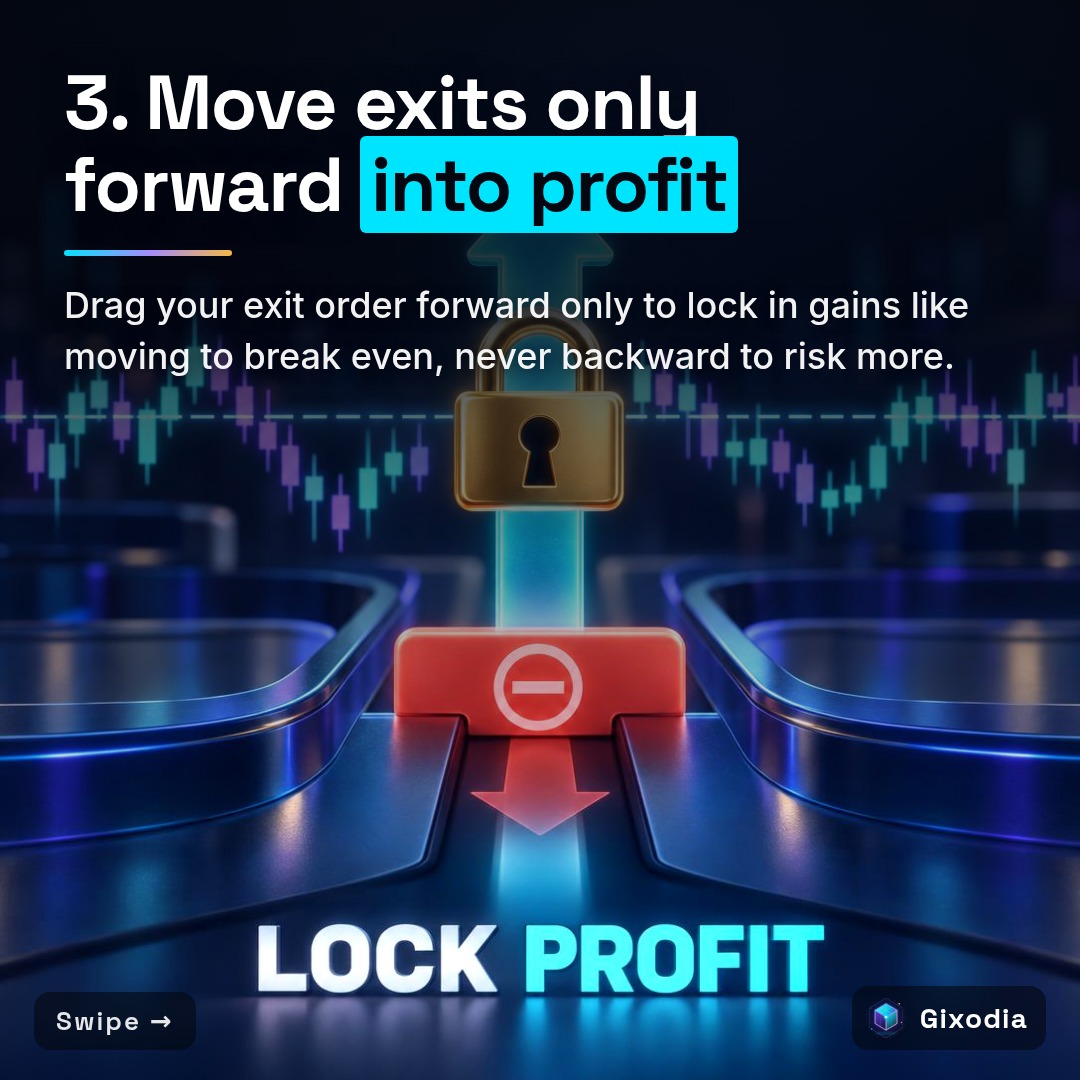
The one-way rule is an absolute risk management guideline dictating that a protective stop loss order may only move in one direction: forward to reduce open risk or secure paper profits, and never backward to allow extra loss.
Under the one-way rule, your stop loss behaves like a ratchet mechanism. Once placed upon order entry, the stop can only advance toward your entry price to reach break-even, or trail behind structural market swings to lock in accrued profits. The line cannot take a single step backward into deeper negative territory.
Treating an exit order as a one-way door removes bargaining from your routine. It forces you to accept the trade outcome decided by your technical system. Applying this discipline consistently aligns with proven methods in risk management mt4 ea pro.
Traders who implement the one-way rule find that trade management becomes simple. If the market trends favorably, the trailing stop protects capital. If the market moves against the initial premise, the trade exits cleanly at the pre-calculated level with no second-guessing.
- Initial stop placement represents maximum allowed risk for that setup.
- Trailing stops advance behind established swing lows for longs or swing highs for shorts.
- Backward adjustments are prohibited under all market conditions.
| Trading Factor | Disciplined Planned Stop | Mid-Trade Widened Stop |
|---|---|---|
| Dollar Risk Exposure | Fixed at initial risk unit (for example 1R) | Expands unpredictably to 2R, 3R, or more |
| Reward-to-Risk Balance | Remains intact as modeled before entry | Collapses into negative mathematical expectancy |
| Trader Mindset | Accepts normal cost of doing business | Stems from panic, denial, and loss aversion |
| Account Recovery Effort | Minor loss recovered with ordinary setups | Requires multiple winning trades just to break even |
| Order Invalidation | Honors technical chart structure cleanly | Ignores technical reality to avoid realizing a loss |
How does emotional attachment drive traders to move stops?
Traders move stops further away due to loss aversion, the psychological pain of realizing a loss, which feels significantly stronger than the pleasure of a comparable gain. This discomfort causes individuals to gamble on low-probability reversals rather than accept being wrong.
When an active position approaches an invalidation line, the brain views the impending exit as a personal failure rather than a normal business expense. To delay the emotional sting of realizing the loss, the trader drags the exit line downward, creating the illusion that the position is still viable.
This mental trap is examined closely in the study of the psychology of automated trading. Manual traders frequently convince themselves that institutional liquidity sweeps are hunting their specific stops, using that excuse to abandon their trade plans entirely.
Professional execution requires understanding that losing trades are an unavoidable component of any statistical edge. By automating your entries and exits, you remove these destructive emotional urges from daily execution.
- Loss aversion tricks traders into taking extreme risks to avoid small, manageable losses.
- Hope replaces analysis the instant a protective stop is moved backward.
- Stepping away from the screen after order submission prevents impulsive tinkering.
How do spreads and platform mechanics trigger stops prematurely?
A stop loss can trigger prematurely when the Bid-Ask spread widens sharply during volatile releases or rollovers, or when platform limitations block adjustments. Short trades trigger on the Ask price, meaning an invisible spread spike can close a position even if the chart price appears untouched.
On trading platforms like MetaTrader 5, standard chart candles map the Bid price. A buy stop protecting a short position executes on the Ask price. If the spread jumps from one pip to ten pips during a low-liquidity period, the Ask line hits the stop order while the candlestick on your screen remains below it. You can explore this mechanic in our guide on understanding spread commission slippage.
Additionally, MetaTrader 5 brokers enforce minimum distances called stops levels. If market volatility drives price too close to your stop level, the platform rejects modifications with an invalid stops message. In fast markets, trying to modify or widen an order manually often fails outright due to freeze levels.
This platform reality means that manual order manipulation during turbulent hours introduces massive technical risk. Setting fixed parameters server-side at the start ensures that execution happens by predefined rules rather than chaotic manual intervention.
- Sell stops trigger on the Bid price; buy stops trigger on the Ask price.
- Spread spikes during daily roll hours can hit resting protective stops.
- MT5 server restrictions prevent last-second stop modifications inside the freeze zone.
How does automated software eliminate stop loss tampering?
Automated trading software eliminates stop loss tampering by executing entries, risk parameters, and exits according to rigid, predefined code on MetaTrader 5, running entirely free of human panic, hesitation, and emotional interference.
One of the primary benefits when comparing bot vs manual trading is operational consistency. Gixodia's trading software is an Expert Advisor running inside MetaTrader 5. It trades by predefined rules, the same way every time, without personal bias or hesitation.
Our trading bot places protective parameters alongside entry orders. As a limit you set gets close, it scales down, and it pauses at that limit. It does not try to predict the market or argue with market flow by dragging exits backward when a trade encounters friction.
Because the software operates strictly by fixed rules on your own broker account, human errors like widening stops or revenge trading are systematically eliminated from day-to-day execution.
- Expert Advisors transmit stop loss orders directly to the server at execution.
- Rule-based trade management prevents discretionary tinkering during open positions.
- Automated systems stick strictly to predefined mathematical parameters.
How to do it, step by step
- Map the technical invalidation level. Identify the exact price point where your technical idea is invalidated on the chart, such as past an established swing low or major support level, before opening your order ticket.
- Calculate lot size to match your fixed risk. Determine your planned cash risk unit, then divide that cash amount by the distance between entry and your technical invalidation price to establish your exact lot size.
- Add a spread buffer for short positions. When selling short, calculate your broker's typical spread buffer and set the buy stop order that many points above structural resistance to protect against normal spread fluctuations.
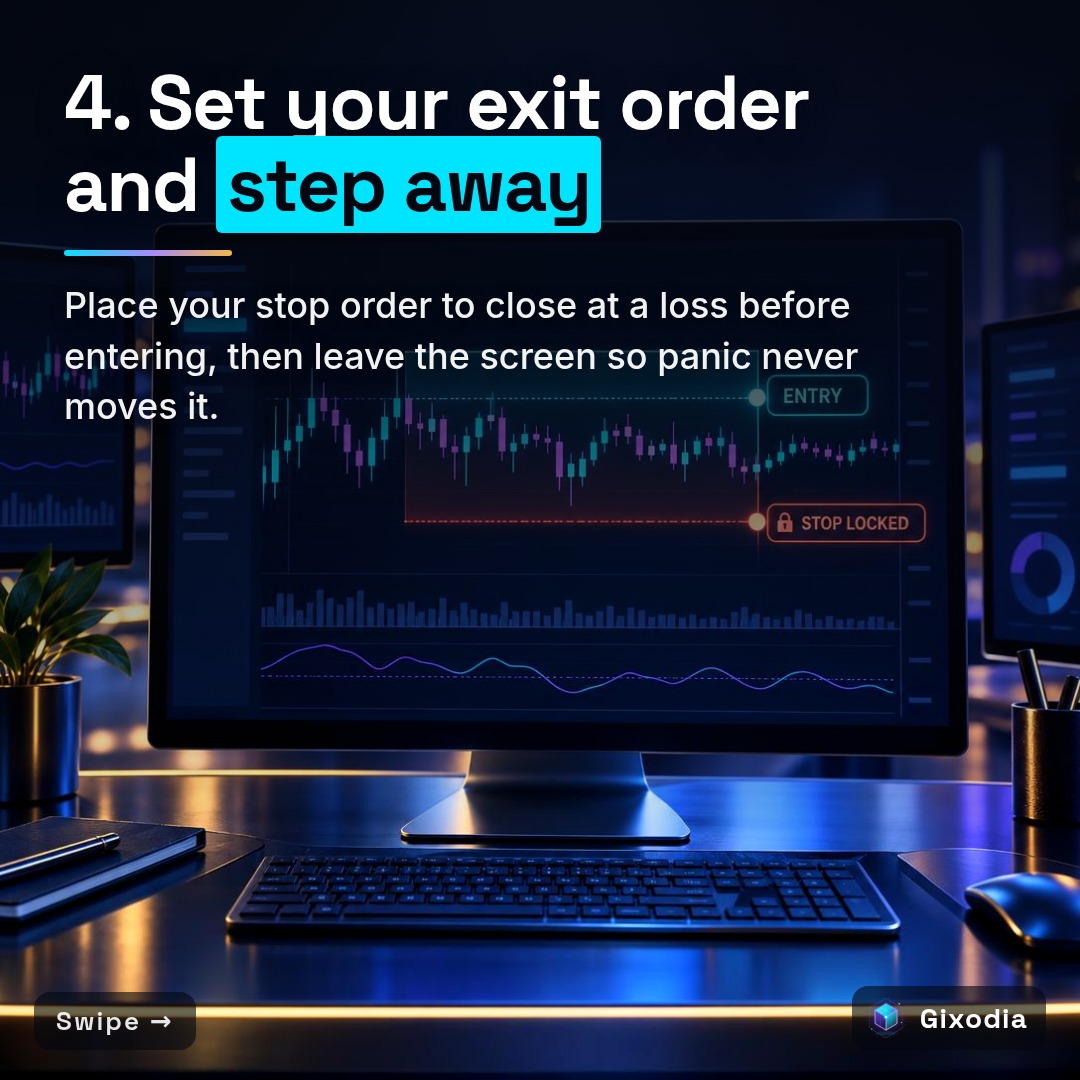
- Attach the stop loss order simultaneously with entry. In MetaTrader 5, input the stop loss price directly in the order placement window so the protective boundary is sent to the broker server the moment your trade opens.
- Enforce the one-way ratchet rule. Adjust your stop order only to reduce risk, such as moving to break-even after market momentum confirms the move, and never drag it backward into deeper negative territory.
- Step away from the active screen. Once your orders are confirmed on the server, close the terminal window or walk away from the chart to prevent emotional impulses from tampering with active positions.
Checklist before you take the trade
- Technical invalidation level is identified before the trade is entered
- Lot size is strictly matched to the distance between entry and the invalidation point
- Spread buffer has been factored into the stop level on short trades
- Stop loss order is entered alongside the trade ticket in MetaTrader 5
- Commitment is made to move the stop only forward to reduce risk or secure profit
- The planned loss is accepted as an ordinary operating expense before clicking buy or sell
Common mistakes and how to fix them
✗ The mistake: Dragging the stop loss further away when price approaches the invalidation level
✓ The fix: Commit to the one-way rule: once placed, an exit order can only move forward toward lower risk or profit, never backward.
✗ The mistake: Ignoring the Ask price line when trading short setups on MT5
✓ The fix: Enable the show Ask line option in platform chart settings and include the spread buffer in your protective stop calculation.
✗ The mistake: Entering trades without a pre-calculated stop loss order attached
✓ The fix: Never execute a market order without predefining and attaching the stop loss within the initial order parameters.
✗ The mistake: Arbitrarily widening stops during high-impact news releases
✓ The fix: Respect your initial technical structure or let predefined rules close the trade if the invalidation level gets triggered.
Frequently asked questions
Why is widening a stop loss considered such a severe trading error?
Widening a stop loss destroys your risk-to-reward ratio and unpredictably inflates the money you can lose on a single trade. Because your lot size was calculated for a smaller distance, extending that distance mid-trade causes losses that can wipe out multiple successful trades.
What is the one-way rule for stop losses?
The one-way rule is a discipline guideline stating that a stop loss order should move only in the direction of reducing risk. You may advance your stop toward break-even or trail it to protect profits, but you must never adjust it backward away from the market price.
Can a stop loss trigger even if the chart candle didn't touch it?
Yes, especially on short positions. Most charting platforms display the Bid price, but short positions are closed by buying at the Ask price. If the spread widens during periods of low liquidity, the Ask price can trigger your stop loss even when the chart candle looks untouched.
What happens if I try to modify my stop loss too close to the current price on MT5?
MetaTrader 5 brokers enforce minimum distances known as stops levels and freeze levels. If the market is too close to your stop order, the platform rejects modifications with an invalid stops error to prevent order book conflicts during fast movements.
How does automated software stop traders from widening their stops?
Algorithmic software executes trades based entirely on predefined rules. An Expert Advisor submits fixed stop orders to the broker server upon entry and follows programmatic logic without emotion, hesitation, or the urge to widen exits.
Want your trading to follow fixed rules, the same way every time? Gixodia's trading software for MetaTrader 5 trades by predefined rules on your own broker account, in your own name. Try it free for 72 hours, a demo account is fine, then $499/year. Trading involves risk and you can lose money.
Sources
- Stop Moving Your Stop Loss: Execute Without Interference - My Framer Site (edgeflo.com)
- Common Mistake: Moving Your Stop-Loss Further Away (samuelandcotrading.com)
- Forex Position Size Calculator: Formula and 1% Risk (ordanemarkets.com)
- wemastertrade.com